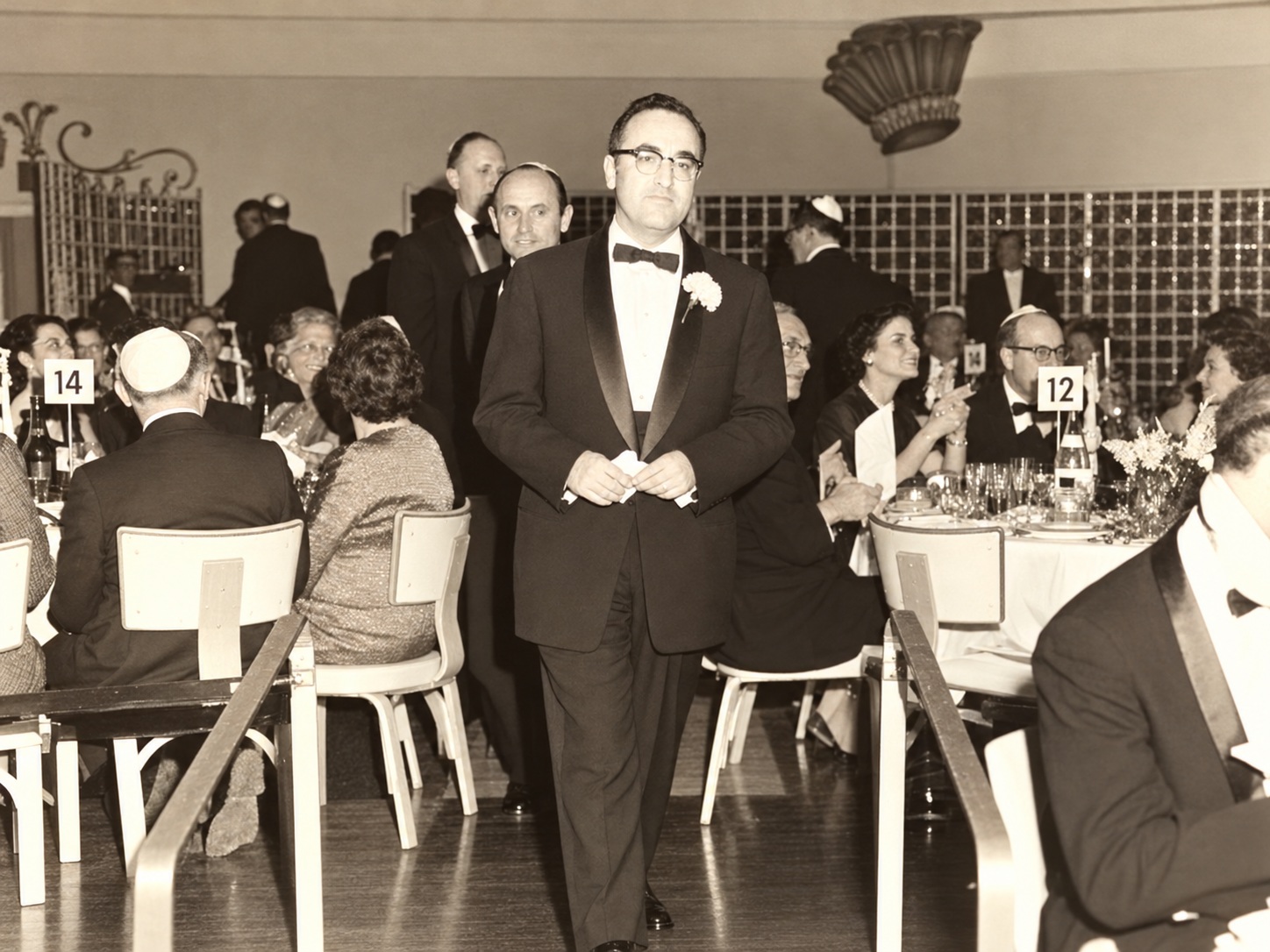
THE LIFE BEHIND THE LIBRARY · 3,159 WORDS
Rabbi Raphael “Ralph” Pelcovitz:
a life of Torah and community.
Rav of the White Shul. Teacher at Torah Vodaas. Sforno translator. Author, communal leader, and a voice remembered by generations.
01 / A LIFETIME OF TORAH
A lifetime of Torah, in public and in person
Rabbi Raphael Pelcovitz, widely known as Rabbi Ralph Pelcovitz, belongs to the history of American Orthodoxy as a congregational rav, teacher, translator, author, and communal leader. His name is inseparable from Congregation Kneseth Israel, the White Shul in Far Rockaway, New York. It is also familiar to readers of Sforno in English, families who learned from his parenting books, and audiences who heard him address the changing responsibilities of Jewish life.
His legacy survives in different forms: the institutions he helped strengthen, the published works that remain on bookshelves, the memories of congregants and colleagues, and recordings in which he speaks for himself. This biography brings those records together. Public honors establish one part of the story; firsthand recollections reveal another—the way a rav’s teaching could remain present in a person’s life long after a particular Shabbos or shiur had ended.
02 / A LIFETIME OF TORAH
From Lithuanian roots to an American childhood
Born in Canton, Ohio, in 1921, Rabbi Pelcovitz grew up in Ohio and Connecticut. His family’s roots lay in Kovno and Lomza. He later recalled his father’s learning at Slabodka and immigration to America in 1916, and his own experience of public school in a small Orthodox minority.
Susan Schwamm’s 2018 profile identifies his father as Rabbi Ephraim Pelcovitz and dates the family’s move to Bridgeport to 1928. It describes public school followed by Talmud Torah in the afternoons. At twelve, Raphael traveled to Eretz Yisroel with his mother and sisters, remained with a sister and brother-in-law, and studied in the mechina of Chevron Yeshiva. The article recalls that he celebrated his bar mitzvah there and returned to America after several years as unrest intensified.
03 / A LIFETIME OF TORAH
Torah Vodaas, Rav Shlomo Heiman, and the work of teaching
Rabbi Pelcovitz entered Yeshiva Torah Vodaas in 1938. Rabbi Yair Hoffman’s memorial identifies him as a talmid of Rav Shlomo Heiman. The link matters to understanding the scholarly seriousness behind a public career often remembered for eloquence and warmth. His sermons and explanatory writing came from a world of close attention to Torah texts.
The Jewish Home’s 2018 profile provides further detail: semicha from Rav Shlomo Heiman at age twenty, the influence of Rabbi Shraga Feivel Mendelowitz, and early teaching in a Talmud Torah while he was a yeshiva student. It describes his affection for a rebbe who taught him both how to learn Gemara and how to communicate that learning. Those skills later served him as a classroom educator, maggid shiur, and congregational rav.
04 / A LIFETIME OF TORAH
Hartford, Saratoga Springs, and Akron: learning to lead
The 2018 Jewish Home profile describes his first substantial role in chinuch as principal of a Jewish day school in Hartford, Connecticut. Over two years, he expanded the school and recruited students while confronting the difficulties of establishing day-school education in that period.
In January 1945 he became rav of the shul in Saratoga Springs, New York, while also serving as principal and teacher of its Talmud Torah. The article remembers a community that grew in the summer as visitors came to the mineral baths. During the rest of the year, he worked to strengthen weekday attendance, particularly on Mondays and Thursdays, alongside Shabbos services.
After two years in Saratoga Springs, he accepted a position in Akron, Ohio. The profile recalls his determination that the new shul retain a proper mechitza and avoid the use of a microphone on Shabbos. Adult learning and personal relationships were part of his response to a community negotiating the pressures of assimilation. His first-person account on Chabad.org also identifies Hartford and Saratoga Springs among the early stages of his career, while the Jewish Home profile supplies the additional Akron chapter.
05 / A LIFETIME OF TORAH
1951: the White Shul and a community taking shape
In 1951, Rabbi Pelcovitz became spiritual leader of Congregation Kneseth Israel. Historian Shnayer Leiman’s recollections describe the following decade as a turning point in the congregation’s growth.
The civic record places this leadership within a wider community-building effort: day schools, yeshivas, summer programs, kosher infrastructure, charities, and religious and social services. These are collective achievements. Rabbi Pelcovitz’s contribution was leadership within that communal work, rather than a claim that one person independently founded every institution in the area.
06 / A LIFETIME OF TORAH
Kashrus, mikveh, eruv, and a new shul
Susan Schwamm’s 2018 account documents practical parts of Rabbi Pelcovitz’s Far Rockaway leadership: helping establish the Vaad Hakashrus and a community mikveh, and working toward an eruv. Citing Dr. Nachum Pelcovitz, the article describes the involvement of Rabbi Shimon Eider and consultation with Rav Moshe Feinstein.
The profile also dates the White Shul’s move to its present location to 1964 and describes consultation with Rav Moshe over the new building’s mechitza. These accounts show how communal expansion was joined to questions of halacha and acceptance within the congregation. They add specific institutions and decisions to the broader civic description of a community builder.
07 / A LIFETIME OF TORAH
Adult learning and the work of chesed
The same profile describes adult Torah classes for men and women, teaching on Shabbos and during the week, and the expansion of the community’s chevra kaddisha. It records teaching the relevant halachos and establishing the seventh of Adar as a day to honor those engaged in chesed shel emes.
His 2016 interview gives a first-person expression of the outlook behind that work. A rav’s responsibilities included teaching and preaching, but also the welfare of people: concern for illness, suffering, and the circumstances of communal life. The full interview and later profile preserve that philosophy in his own words and in the recollections of his family.
08 / A LIFETIME OF TORAH
A rav remembered by the people who heard him
Joseph C. Kaplan’s recollections give the institutional history a personal scale. Writing in 2018, he remembered growing up in Rabbi Pelcovitz’s congregation in the 1950s and 1960s, then returning for sermons on Shabbos and the Yamim Noraim over many years. Later telephone greetings still brought a berachah and a dvar Torah in response.
Kaplan’s 2022 reflection on his Far Rockaway childhood again recalled Rabbi Pelcovitz’s speaking, the youth minyan, and the people who formed the shul’s daily life. He named Rabbi and Frumie Pelcovitz among those remembered figures. Such testimony does not supply a complete family chronology, but it preserves the human setting in which the public record unfolded.
09 / A LIFETIME OF TORAH
Giving younger congregants a place in the shul
Leiman records a youth minyan, mentors, and opportunities for children to lead services. A surviving announcement documents Youth Shabbos on February 11–12, 1955.
The later recollection by Kaplan of learning to daven in that beis medrash gives another perspective on the same communal world. A youth program was part of how a congregation reproduced its knowledge, confidence, and habits of belonging. Those memories help explain why its influence remained vivid decades later.
10 / A LIFETIME OF TORAH
Rabbi Emanuel Rackman and shared communal life
Leiman remembers Rabbi Pelcovitz and Rabbi Emanuel Rackman cooperating for Jewish life and celebrating Simchas Torah together. Their congregations had distinct identities within one larger community.
Kaplan’s memories place both leaders in the landscape of his youth, distinguishing Rabbi Rackman’s youth-group teaching from the White Shul’s influence. Their work reached people through different settings, while strengthening the wider communal fabric.
11 / A LIFETIME OF TORAH
The Rabbinical Alliance of America and national service
Rabbi Pelcovitz’s work extended beyond one congregation. The Rabbinical Alliance of America, also known as Igud HaRabbonim, identifies him as a founding member and past president. In its March 2019 account of a gathering of national and local rabbis at the White Shul, the organization remembered him as a central figure in the Far Rockaway and Five Towns rabbinate.
The Orthodox Union’s 2008 profile records his service on its Board of Directors and lectures across the United States and Israel. A career rooted in one neighborhood also became a national contribution through speaking, institutional service, and the exchange of ideas among rabbanim.
12 / A LIFETIME OF TORAH
A published voice on the rabbinate, Israel, and Jewish life
The Agudath Israel archive preserves a substantial trail of his periodical writing. Its October 1967 issue of The Jewish Observer lists The Rabbi and the Rosh Yeshiva. The title locates him in a serious discussion about the relationship between the congregational rabbinate and yeshiva leadership.
The September 1969 issue contains his essay Israel’s State of War—Israel’s State of Mind, subtitled as a reckoning two years after the Six Day War. It considers the effect of continuing conflict on Jewish life and the value attached to each individual. The October 1970 archive lists Security, Illusion and Reality—Succos Reflections. Together, these records show an author addressing both public circumstances and religious reflection, long before his later books appeared.
13 / A LIFETIME OF TORAH
An American communal voice concerned with Israel
The Congressional Record for June 1, 1970 preserves a telegram dated May 26 from Congregation Kneseth Israel, bearing the names Ralph Pelcovitz and Harry Schneider. Printed in Representative Joseph Addabbo’s remarks, it condemned a terrorist attack in northern Israel and urged action concerning Israel’s security. The record documents a specific act of communal advocacy; it does not imply a government office or political appointment.
His essay from the preceding year provides a complementary record of concern for Israeli society under the pressure of continuing conflict. Read together, the two documents show both reflective writing and practical public engagement. They are useful historical evidence of the range of responsibilities an American congregational rav could take upon himself.
14 / A LIFETIME OF TORAH
Recognition in 1977 and 2008
Jewish Telegraphic Agency’s May 18, 1977 report records the presentation of the National Rabbinic Leadership Award to Rabbi Ralph Pelcovitz at the Union of Orthodox Jewish Congregations of America’s anniversary dinner. This earlier distinction adds an important milestone to a career sometimes summarized only through its later honors.
In April 2008, the Orthodox Union honored him with its Lifetime Rabbinic Achievement Award, alongside six other veteran rabbanim. Its profile also records the Ben Zakkai Honor Society’s Enid and Harold H. Boxer Memorial Award, for which the year remains unconfirmed in these sources.
15 / A LIFETIME OF TORAH
Sforno on Chumash: translation as a lasting contribution
Among Rabbi Pelcovitz’s enduring contributions is his English translation and annotation of Rabbi Ovadiah Sforno’s commentary on Chumash. A contemporary review in the March 1988 Jewish Observer identifies the Bereishis–Shemos volume as a 1987 Mesorah publication. The reviewer describes translation, explanatory notes, introductory treatment of recurring themes, and attention to the text underlying the commentary.
This is more precise than assigning the whole project the release date of a later edition. The current ArtScroll set belongs to the publication history of a work whose earlier form was already being discussed in the 1980s. The library’s book page separates the modern set from that early record and links readers to publisher details. Translation and annotation made a compact commentary available to readers who needed more than a word-for-word rendering to follow its meaning.
16 / A LIFETIME OF TORAH
Sforno on Pirkei Avos and the language of character
Sforno on Pirkei Avos extended his work as a translator and commentator into the ethical teachings of Avos. ArtScroll’s record identifies a Hebrew–English volume combining the commentary with Rabbi Pelcovitz’s explanatory work. The book is a distinct part of his bibliography, rather than another title for the Chumash translation.
Placed alongside his later writing on parenting and personal growth, the volume reveals a sustained interest in the formation of character. A reader can approach the older commentary through translation while retaining contact with the Hebrew text. The site’s dedicated book record supplies the edition’s bibliographic information and a route to the publisher, so readers looking for Sforno on Avos can distinguish it from Sforno on Torah.
17 / A LIFETIME OF TORAH
Table Talk and the Torah of the Shabbos table
Table Talk: Shabbos and Yom Tov Divrei Torah brought his teaching into another setting: learning shared around the family table. Yeshiva University’s 2005 publication announcement lists it among his earlier books, together with his Sforno works. The title remains a useful point of entry for readers seeking his approach to the weekly parsha and the festivals.
The book also belongs within a larger speaking career. A published collection necessarily preserves only selected material. Rabbi Yair Hoffman, recalling Rabbi Pelcovitz’s parsha notes, explicitly distinguished the published drashos from a much larger body of unpublished work. That observation gives the preservation of recordings and manuscripts a particular importance: the existing bookshelf does not represent every teaching he delivered.
18 / A LIFETIME OF TORAH
Balanced Parenting: a rav and a psychologist in conversation
Balanced Parenting, published in 2005, joined Rabbi Pelcovitz’s rabbinic experience with the clinical perspective of his son, Dr. David Pelcovitz. Yeshiva University’s contemporary announcement names both authors and describes practical concerns including motivation, values, anger, peer pressure, self-respect, loss, and children facing particular challenges.
The collaboration continued in public teaching. The Orthodox Union announced a February 2011 parenting program at Manhattan Day School with the father and son as keynote speakers. Their joint appearance shows that the book was connected to a wider effort to discuss family life with parents. It also establishes a specific relationship between Rabbi Pelcovitz’s work, Jewish education, and the professional expertise of Dr. David Pelcovitz, rather than attributing the son’s separate academic positions to his father.
19 / A LIFETIME OF TORAH
Life in the Balance and the work of personal growth
Life in the Balance: Torah Perspectives on Positive Psychology continued the father-and-son collaboration. The National Library of Israel catalog identifies Rabbi Raphael Pelcovitz and Dr. David Pelcovitz as the authors. The work is represented in the library’s bookshelf separately from Balanced Parenting, with its own subject, edition, and publisher link.
Its focus brings Torah perspectives into conversation with positive psychology and the development of personal strengths. Within Rabbi Pelcovitz’s bibliography, that subject belongs alongside the ethical concerns of Pirkei Avos and the practical responsibilities of family life. The books address different audiences and settings, but they share an interest in how learning becomes conduct: the habits, decisions, relationships, and character through which a person lives.
20 / A LIFETIME OF TORAH
Teaching beyond Far Rockaway: Bialystoker and Torah Umesorah
A Winter 2003 newsletter from Bialystoker Synagogue documents Rabbi Ralph Pelcovitz introducing Sefer Devarim in a women’s learning program organized with Torah Umesorah. The newsletter describes an audience drawn from New Jersey, Manhattan, and Brooklyn and distinguishes his presentation from the subsequent Tehillim session taught by Dr. Esther Rister.
This congregational record provides a concrete example of the wider speaking activity described in national profiles. It also broadens the picture of his audience. His teaching was not confined to the Shabbos pulpit or to one age group. Women’s learning programs, communal lectures, and family education offered other settings in which listeners encountered his Torah. Linking the original announcement makes the event verifiable without implying that its recording is now held in this archive.
21 / A LIFETIME OF TORAH
The changing American rabbinate: the 2008 roundtable
In January 2008, Jewish Action convened Rabbis Rafael Grossman, Joseph Grunblatt, David Hollander, Gilbert Klaperman, Ralph Pelcovitz, Fabian Schonfeld, and Max Schreier for a discussion moderated by Stephen J. Savitsky. The published conversation examined American Orthodox life, the role of the synagogue, education, outreach, and the responsibilities of the rav.
Rabbi Pelcovitz’s remarks are valuable because they place his experience beside the experiences of colleagues serving other communities. His observations about changing generations are part of a broader discussion, not a statement that every speaker’s comments were his own. The original article allows readers to follow those distinctions. It preserves him as an active participant in debate about the direction of American Jewish life, as well as a recipient of the honors that followed.
22 / A LIFETIME OF TORAH
A conversation with Rabbi Berel Wein
The White Shul’s May 2014 bulletin announces a May 14 conversation with Rabbi Berel Wein and Rabbi Raphael Pelcovitz on synagogues, rabbanim, and lay leadership. Rabbi Wein’s Destiny catalog separately lists an audio lecture under the title Synagogues, Rabbis and Lay Leadership with Rabbi Ralph Pelcovitz.
These two records document both the announced conversation and the external recording listing. They provide another route into his reflections on communal service, and a useful connection for readers researching Rabbi Berel Wein’s conversations with other rabbinic figures. The recording remains with its external publisher. A catalog link here is an invitation to explore that source, not a claim that the audio has been downloaded, transcribed, or republished on this site.
23 / A LIFETIME OF TORAH
His own voice: JEM, Chabad.org, and the Lubavitcher Rebbe
Jewish Educational Media interviewed Rabbi Pelcovitz at home in October 2010. Chabad.org preserves the written account and On the Mark, a video recalling his late-1950s discussion with Rabbi Menachem Mendel Schneerson. He describes the meeting through his involvement with Igud HaRabbonim and remembers the Rebbe’s concern for his father. The recordings let a new audience encounter his voice and manner directly.
24 / A LIFETIME OF TORAH
A communal ethic carried forward after Sandy
The Orthodox Union’s report on the White Shul’s first-anniversary commemoration of Hurricane Sandy, published October 29, 2013, records a revealing attribution. Congregational president Chaim Leibtag credited Rabbi Pelcovitz with teaching the importance of community while describing the help the shul offered after the storm under Rabbi Eytan Feiner’s leadership.
The distinction matters. The report does not assign every relief action to Rabbi Pelcovitz personally. Instead, it describes an inherited communal outlook expressed through practical assistance in a later crisis. That is one way to understand a long rabbinate: its influence may continue in the assumptions a congregation carries into its next challenge. The original report supplies the names, setting, and context rather than turning communal gratitude into an unsupported list of individual achievements.
25 / A LIFETIME OF TORAH
Family, collaboration, and the small work behind a shiur
In Jewish Action’s 2017 feature on the children of communal leaders, Dr. David Pelcovitz remembered preparing the room and arranging seforim before his father taught. This modest memory gives another view of the later coauthor relationship. Participation in communal work began with practical tasks, not only with the books for which father and son became known.
The family record also includes the anniversary recording preserved in this library under the supplied title Rabbi and Frumi Pelcovitz—40th Anniversary. Public death notices in 2018 identify his surviving wife, Shirley, and children Ethel Gottlieb, Judy Gribetz, David Pelcovitz, and Nachum Pelcovitz. These records belong to different moments in a long family history; the biography does not treat every name as evidence for an unverified marriage date or family relationship.
26 / A LIFETIME OF TORAH
Sixty-five years, remembered by his congregation
The White Shul’s December 2016 bulletin announced an anniversary Shabbos on December 3, Parshas Toldos, marking 65 years of Rabbi Pelcovitz’s service. The congregation’s own announcement is the primary basis for the milestone used throughout this site. It refers to the long relationship that included his years as rav and rabbi emeritus.
The Jewish Home cover preserved in this archive provides a further public reminder of that celebration. Its link now opens the original issue supplied on Issuu. The cover image and the issue reader serve different purposes: one lets a visitor see the historical cover quickly; the other takes the reader to the publication itself. Neither is presented as a substitute for reading the full article when verifying its detailed claims.
27 / A LIFETIME OF TORAH
2018: mourning, memory, and a continuing record
Rabbi Pelcovitz passed away on March 14, 2018. Contemporary reporting announced the levayah at the White Shul and burial arrangements in Jerusalem. Memorial accounts emphasized scholarship, speaking, writing, and his long relationship with Far Rockaway. They should be read as tributes by particular writers rather than as interchangeable factual inventories.
The June 11, 2018 memorial dinner presentation linked in the media archive offers another form of remembrance. Its title, event date, and 14:47 running time have been identified. A complete transcript was not available in this review, so the biography does not attribute unverified quotations or participant names to its spoken content. Further recordings can deepen the account when their contents and permissions are established.
28 / A LIFETIME OF TORAH
A name in the city’s record
New York City’s December 20, 2018 stated-meeting record includes Rabbi Raphael “Ralph” Pelcovitz Way in its commemorative street-name legislation. The accompanying account recognizes his service to the Rockaways, educational work, authorship, and support for Jewish communal infrastructure. Queens Name Explorer preserves a related civic biography.
The honor places a public marker beside a much larger body of living work. The strongest account of that work remains cumulative: a source for a particular award, a congregation’s own bulletin, a publisher’s bibliographic record, a preserved essay, and the testimony of people who knew him. The purpose of this library is to keep those routes open and to make it easier for a new reader or listener to discover his Torah.
Based on original writings, institutional records, contemporary reporting, and attributed recollections. Dates are given as precisely as the sources support. Age reports differ; the documented year range 1921–2018 is used. Video descriptions identify verified metadata and do not imply a complete transcript. Explore the source directory ↗